
Blockchain Beyond Cryptocurrency
Exploring How Blockchain is Transforming Industries Worldwide
BLOCKCHAINCRYPTOCURRENCY
By Indacy Group Editorial Team
6/8/20263 min read
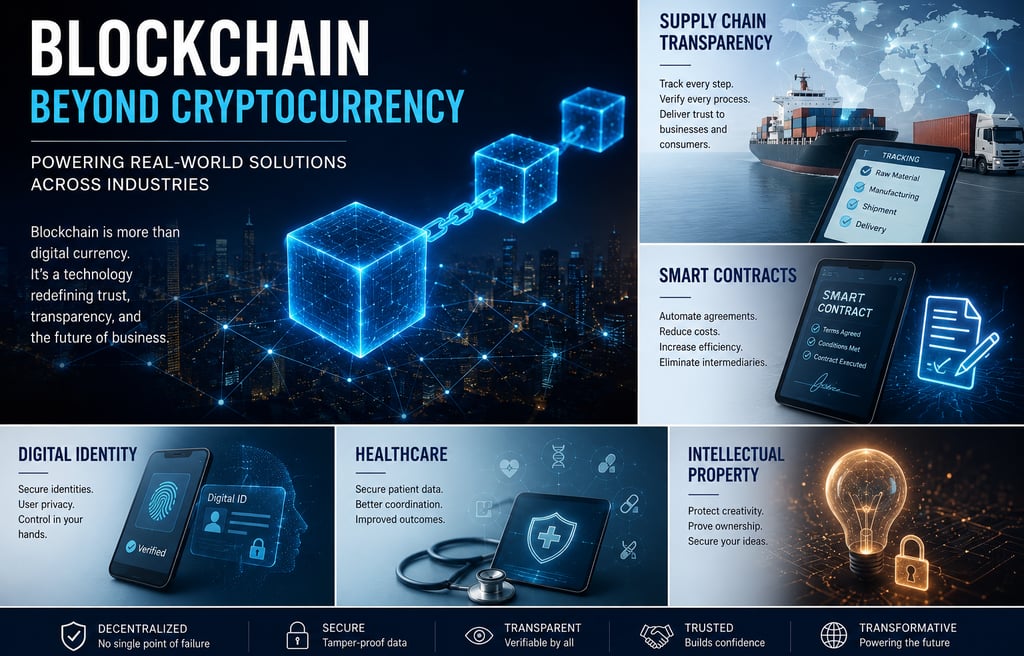
Blockchain Beyond Cryptocurrency
Exploring How Blockchain is Transforming Industries Worldwide
When most people hear the word blockchain, they immediately think of cryptocurrencies like Bitcoin or Ethereum. While digital assets introduced blockchain technology to the world, cryptocurrency is only one application of a much larger innovation.
Today, blockchain is transforming industries ranging from finance and healthcare to supply chains, real estate, education, and digital identity. Businesses and governments are increasingly recognizing blockchain as a technology that enhances transparency, security, and efficiency.
What Is Blockchain?
Blockchain is a decentralized digital ledger that securely records transactions across multiple computers. Unlike traditional databases managed by a single organization, blockchain distributes information across a network, making records transparent, verifiable, and extremely difficult to alter.
Every transaction becomes part of a permanent chain of data, creating trust without requiring a central authority.
This fundamental shift opens new possibilities for how businesses manage information and collaborate across borders.
Beyond Digital Payments
Although cryptocurrency remains the most recognized use case, blockchain is now solving real-world business challenges.
Organizations are using blockchain to:
Improve operational transparency
Reduce fraud
Streamline cross-border transactions
Secure sensitive records
Increase trust between business partners
Automate agreements through smart contracts
These capabilities are attracting interest from both private companies and public institutions worldwide.
Supply Chain Transparency
Global supply chains often involve multiple manufacturers, distributors, logistics providers, and retailers.
Blockchain enables every stage of a product's journey to be securely recorded, allowing businesses and consumers to verify authenticity, origin, and movement.
This is especially valuable in industries such as:
Luxury goods
Pharmaceuticals
Food production
Fine art
Electronics
Greater transparency helps reduce counterfeit products while improving consumer confidence.
Digital Identity
Identity verification remains one of the largest challenges in today's digital economy.
Blockchain-based digital identity systems could allow individuals to securely control their own credentials instead of relying on multiple centralized databases.
Potential benefits include:
Faster identity verification
Reduced identity theft
Improved online privacy
Simplified access to financial and government services
Smart Contracts
One of blockchain's most powerful innovations is the smart contract.
A smart contract is a self-executing digital agreement where predefined conditions automatically trigger specific actions.
Examples include:
Automatic payments after delivery confirmation
Digital licensing agreements
Insurance claim processing
Real estate transactions
Business partnership agreements
By reducing manual processes, smart contracts can improve efficiency while lowering administrative costs.
Healthcare and Secure Data
Healthcare organizations manage highly sensitive information that requires both privacy and accessibility.
Blockchain can help create secure medical records that remain accessible to authorized healthcare providers while protecting patient privacy.
Potential applications include:
Medical record management
Prescription tracking
Clinical research
Health insurance verification
Intellectual Property Protection
Creators, artists, designers, and innovators increasingly seek stronger methods to protect ownership of their work.
Blockchain provides immutable timestamps and verifiable ownership records, helping establish authenticity and provenance for digital and physical assets.
As digital economies expand, this capability may become increasingly valuable.
Building Trust in a Digital Economy
One of blockchain's greatest strengths is its ability to create trust between parties that may not know each other.
Instead of relying solely on intermediaries, blockchain provides transparent records that participants can independently verify.
This has the potential to reshape how businesses collaborate across international markets.
Looking Ahead
Blockchain technology is still evolving, and widespread adoption will require continued innovation, regulatory clarity, and industry collaboration.
However, its potential extends well beyond cryptocurrencies.
As businesses explore new ways to improve security, efficiency, and transparency, blockchain is emerging as one of the foundational technologies of the digital economy.
Organizations that understand its broader applications today may be better positioned to adapt to tomorrow's business landscape.
Conclusion
Blockchain is no longer simply the technology behind cryptocurrency.
It is becoming an infrastructure for trusted digital interactions across industries.
From supply chain management and healthcare to digital identity and smart contracts, blockchain offers opportunities to improve the way information is shared, verified, and protected.
As adoption continues to grow, businesses that embrace innovation while maintaining responsible governance will be well positioned for the future.
Address
Indacy Group LLC — Georgia
Tech Solutions & Creative Publishing
Terms
Identification Number: 431185193
Contact
Tech & Innovation
+995 551 313 786 | tech@indacygroup.com
Media & Publications